24-Hour & Intensive Supported Living

Support that stays present. Life that stays yours.

Some adults need support that is available throughout the day and night, or a more intensive arrangement for part of their journey. The purpose is not constant control. It is to create reliable conditions for safety, stability, participation and progress while preserving the supported-living foundation.

Reliability without intrusionSupport is organised around assessed need—not around a standard package.
Understanding The Model

Available around the clock does not automatically mean one-to-one every minute.

Assessment, commissioning, the environment and the person’s plan determine what support is available, when it is delivered and whether it is shared or individual.

Round-the-clock availability

A dependable support presence across the full day.

This may mean staff are available within or close to the setting throughout the day and night. The arrangement should describe how assistance is accessed, what staff are responsible for and how individual needs are met.

Not continuous observationAvailability should not remove ordinary privacy or personal space.
Clear response arrangementsThe person and team understand how support can be requested or offered.
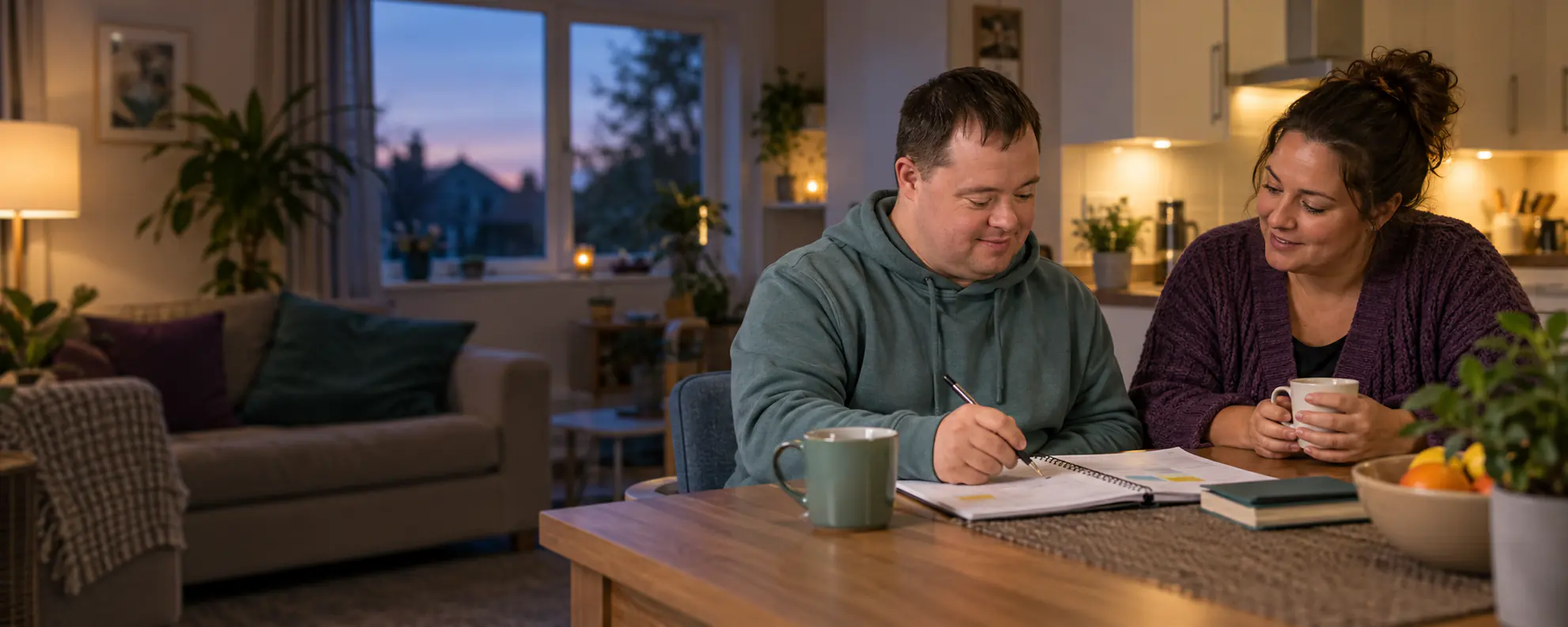
Planning support together at home
Individual support hours

Dedicated time connected to meaningful outcomes.

One-to-one hours may support communication, community activity, appointments, skills, emotional regulation or other assessed needs. They should have a clear purpose and remain subject to review.

Outcome-linkedHours connect to the person’s goals and assessed requirements.
Reviewed properlyThe level and purpose of input can change as circumstances develop.
A person enjoying an engaging activity with support
Overnight arrangements

Night support can take different forms.

Depending on assessed need and commissioning, the model may include waking-night support, a sleep-in arrangement, on-site availability or another clearly planned response.

Assessment before assumptionOvernight provision should not be inferred from a label alone.
Rest and privacySafety planning should protect a settled home environment.
A supportive conversation in a homely setting
Intensive periods

More input may be useful at particular stages, not necessarily forever.

Intensity may increase during transition, deterioration, significant change or skill development. It may later be reconsidered through evidence, multidisciplinary input and proper review.

ResponsiveSupport adapts when needs, strengths or risks materially change.
ProportionateGreater intensity should not become an unexamined permanent restriction.
A thoughtful one-to-one support conversation
Understanding the model

Available around the clock does not automatically mean one-to-one every minute.

The phrase can describe different arrangements. Assessment, commissioning, the environment and the person’s plan determine what support is available, when it is delivered and whether it is shared or individual.

Round-the-clock availability

A dependable support presence across the full day.

This may mean staff are available within or close to the supported-living setting throughout the day and night. The arrangement should describe how assistance is accessed, what staff are responsible for and how individual needs are met.

Not continuous observation

Availability should not remove ordinary privacy or personal space.

Clear response arrangements

The person and team understand how support can be requested or offered.

Individual support hours

Dedicated time should have a clear person-centred purpose.

One-to-one or other individual input may support appointments, community participation, communication, daily living, emotional regulation, skill development or identified risk-management outcomes.

Outcome-linked

Hours connect to assessed needs and meaningful goals.

Reviewed properly

The level and purpose of input can change as circumstances develop.

Overnight arrangements

Night support can take different forms.

Depending on assessed need and commissioning, an arrangement may include waking-night support, a sleep-in arrangement, on-site availability or another clearly planned response. The model must match the person and the setting.

Assessment before assumption

Overnight provision should not be inferred from a label alone.

Rest and privacy

Safety planning should still protect a settled, ordinary home environment.

Intensive periods

More support may be useful at particular stages—not necessarily forever.

Intensity may increase during transition, deterioration, significant change or skill development. It may later be reconsidered through evidence, multidisciplinary input and proper review.

Responsive

Support adapts when needs, strengths or risks materially change.

Proportionate

Greater intensity should not become an unexamined permanent restriction.

Interactive Support Design

Explore intensity as a responsive setting, not a permanent label.

Move the control to see how emphasis can change. The examples are illustrative; assessment and commissioning remain essential.

Support intensity

Adjust the level of planned input

FoundationEnhanced
Current illustrationFocused individual input
Responsive configuration

Individual hours around identified outcomes.

Dedicated input can support particular routines, activities, transitions and agreed goals while shared availability remains in place.

Purposeful time

The person understands what the support is intended to enable.

Active review

The arrangement changes when evidence and lived experience indicate it should.

Support across the day

Continuity when it matters. Space when it does not.

Swipe or use the indicators to explore how a 24-hour arrangement can remain responsive to ordinary daily life rather than controlling it.

A day shaped around the person

Morning

A familiar start without a rigid script.

Support may help the person understand the day, organise medication or appointments where relevant and make active choices about their priorities.

  • Communication in a familiar form
  • Support offered at the agreed pace
  • Routines that build confidence rather than dependence
Daytime

Participation beyond passive supervision.

Individual support can help someone travel, attend appointments, learn, shop, pursue interests, maintain relationships and practise everyday skills.

  • Meaningful activity linked to personal goals
  • Opportunities adjusted to current confidence
  • Support that does with rather than routinely for
Evening

A calm transition into the person’s preferred evening.

Clear communication and familiar support may help with meals, relaxation, relationships, planning and any agreed evening routine.

  • Choice over how time is spent
  • Relevant information carried between staff
  • Early response when wellbeing changes
Night

Safety and reassurance without turning home into surveillance.

Overnight provision follows the assessed plan. Staff responsibilities, escalation arrangements and the person’s privacy should be clearly understood.

  • Appropriate availability during the night
  • Focused handover of relevant information
  • Review when sleeping patterns or needs change
Support Across The Day

Continuity when it matters. Space when it does not.

Scroll through the moments. The visual and progress state change with the section while mobile visitors can swipe the cards naturally.

Planning the day together at home
A person participating in an engaging activity
Practical support with everyday shopping
A calm support conversation
MorningA familiar start without a rigid script.

01 — MORNING

A familiar start without a rigid script.

Support may help the person understand the day, organise medication or appointments where relevant and make active choices about priorities.

  • Communication in a familiar form
  • Support offered at the agreed pace
  • Routines that build confidence rather than dependence
02 — DAYTIME

Participation beyond passive supervision.

Individual support can help someone travel, attend appointments, learn, shop, pursue interests, maintain relationships and practise everyday skills.

  • Meaningful activity connected to personal goals
  • Opportunities adjusted to current confidence
  • Support that does with rather than routinely for
03 — EVENING

A calm transition into the preferred evening.

Clear communication and familiar support may assist with meals, relaxation, relationships, planning and any agreed evening routine.

  • Choice over how time is spent
  • Relevant information carried between staff
  • Early response when wellbeing changes
04 — NIGHT

Safety without turning home into surveillance.

Overnight provision follows the assessed plan. Responsibilities, escalation arrangements and the person’s privacy should be clearly understood.

  • Appropriate availability during the night
  • Focused handover of relevant information
  • Review when sleeping patterns or needs change
Person-Centred Decisions

More support must still mean more influence over everyday life.

Use the decision console to explore how identity, communication, rights and meaningful outcomes remain active within a highly supported arrangement. These are working principles, not decorative promises.

Communication Before Compliance

Choice only exists when information is accessible.

Communication methods, processing time, sensory needs, culture and identity should shape how options are explained and how consent, preference or concern is recognised.

UnderstandableInformation is adapted to the person rather than repeatedly presented in the same form.
Two-WayStaff listen for meaning and record what the person is communicating.
A support worker listening during a conversation at homePerson-Led Signal
An Ordinary Home

Availability does not remove privacy.

Staff presence should be organised around assessed need while protecting personal space, preferred routines, relationships and the ordinary experience of living in one’s own home.

Personal SpaceSupport is offered with clear boundaries and respect for private time.
Individual RhythmDaily life is not forced into one institutional timetable.
A person relaxing in a comfortable homePrivacy Protected
Progress With Meaning

Outcomes should belong to the person.

Review should consider confidence, relationships, wellbeing, interests and participation—not only incidents, tasks completed or measures selected by services.

Co-ProducedGoals connect to what the person wants to develop, retain or experience.
Strengths-BasedExisting ability is recognised and used as the starting point.
A person taking part in a meaningful everyday activityGoals Stay Live
Least Restrictive Practice

Greater need is not permission for greater control.

Any restriction requires a clear lawful basis, a defined purpose and regular reconsideration. Positive risk planning should support participation while responding proportionately to identified concerns.

NecessaryThe reason is explicit, individual and connected to current evidence.
ReviewedThe plan records how and when proportionality will be reconsidered.
A person and support worker planning togetherRights In Practice
Coordinated support

One person. One coherent direction across the whole day.

Where several people contribute, responsibilities and communication routes need to be understood. Scroll through the flow to see how information becomes coordinated action without excluding the person or blurring professional roles.

Listen and notice

The support team

Consistent practice, observation, encouragement, communication and focused handover across the day.

Everyday continuity

Advise within remit

Health professionals

Specialist assessment, clinical advice and treatment remain clear, proportionate and connected to the wider plan.

Clinical responsibility

Plan and review

Commissioners and social care

Assessment, funding, statutory responsibilities and review provide a clear framework for the arrangement.

Planning and accountability

Protect trusted relationships

Family and chosen people

Involvement follows consent, the person’s wishes and the value of their established relationships.

Personal network

A Coordinated Relay

Information moves. Responsibility stays clear. The person stays central.

Scroll through the relay. Each contribution activates in sequence while maintaining consent, professional boundaries and a coherent direction.

Everyday continuity

The support team

Observation, communication, encouragement and focused handover keep daily support consistent.

Clinical responsibility

Health professionals

Specialist assessment, advice and treatment remain within each professional remit.

Planning and accountability

Commissioners and social care

Assessment, funding, statutory duties and proportionate review provide a clear framework.

Personal network

Family and chosen people

Involvement follows consent, the person’s wishes and the value of trusted relationships.

Accessing Intensive Support

A considered pathway, not an automatic package.

The live panel follows the visitor through each stage, replacing disconnected cards with one coherent process.

Referral information

Available information is shared so the broad request, current circumstances and possible pathway can be understood.

Individual assessment

Needs, strengths, communication, risks, routines, overnight needs and personally meaningful goals are explored.

Support design

The environment, staffing, individual hours, shared availability and coordination are considered together.

Planned transition

Visits, familiarisation, information-sharing and preparation are paced around the person.

Early review

The arrangement is reviewed against lived experience, safety, wellbeing, outcomes and emerging needs.

The wording “24-hour” or “intensive” is not enough to define a service. Suitability depends on the purpose and organisation of support, the proposed environment, compatibility, commissioning and whether the service can safely meet assessed needs.

Make A Referral

Questions About Intensive Support

Clear answers, organised around the decision you are making.

Filter the questions by subject and open only the information you need. Suitability, staffing and overnight arrangements remain subject to individual assessment, commissioning and service-specific consideration.

No. Round-the-clock availability and continuous individual support are different concepts. Individual hours, shared provision and overnight arrangements depend on assessed need, commissioning and service design.

No. Overnight provision may include waking-night support, a sleep-in arrangement, on-site availability or another planned response. The correct model must be established through assessment.

Potentially. Support should remain proportionate and be reviewed as needs, risks, confidence and independence change. Any adjustment must be agreed and introduced safely.

No. Supported living is based on the separation between housing and support. A staffed environment or substantial support input does not by itself convert somebody’s home into residential care.

It may be relevant where transition requires structured risk planning, reliable availability and multidisciplinary coordination. Suitability cannot be confirmed from a pathway label alone.

Assessment considers the person’s needs and preferences alongside accessibility, location, household dynamics, existing residents and whether the proposed support can be delivered safely.

It should not. The purpose of additional support is to establish the conditions in which a person can participate, make decisions, develop confidence and exercise rights as safely as possible.

Useful information may include current needs, strengths, communication, routines, risks, overnight requirements, professional involvement, preferred location and the outcomes the proposed arrangement should support.

Let’s explore the right level of support, not simply the highest level.

Share the available referral information with Moreways so the person’s needs, strengths, proposed environment, overnight arrangements and appropriate next assessment step can be discussed.

Discuss A Referral